Wednesday, January 23, 2013

Tips for Authors Who Are Signing : ALA Midwinter 2013


I’m so sad that I won’t be making it to ALA Midwinter this year. As an English teacher and amateur librarian (a few friends and I curate small collections of favorite books for libraries/schools in need around the world), I like to keep tabs on the library world and mingle with like-minded book lovers. And I tend to be an author lecture/signing junkie. That said, I thought I’d give a list of my observations/preferences  for lucky authors who will be promoting their books at ALA this year.

1.       Keep the lines moving. Or not. I’m on the fence about this one. I hate waiting in line for an hour to get an ARC signed, but it does build suspense (also good friendships with other librarians/teachers). And there is something visually exciting about a long line. It’s the “what’s that? Who has a long line? Must be good. I want in.” Phenomenon.  If ALA is a place to build buzz, a long line can do that, I suppose.


2.       Ask each person’s name and quickly try to find common ground. Look at a nametag. Talk about a place. Give a compliment specific to the person. As book advocates, we want to connect to the authors behind the books so that we feel excited to hype their books. But, as stated in #1, if you spend too much time talking to any one person we might leave the line figuring we won't get to the front of the line in time to meet you, especially if we aren't die-hard fans of your work yet.


3.       Something special in the signature. I often read the books first then give them away as prizes in my classroom (good opportunity to talk about upcoming books/authors and get kids excited to read) so I don’t get a lot of them personalized to me. That said, it’s nice to have something special in the signature. Many authors opt for taglines (often some form of pun on the title), which is fine, but my favorite generic signatures feel more alive. Recently my friends and I purchased Beck’s new sheet music “album” as signed first editions from Mc Sweeneys. When they arrived, we compared signatures and died laughing. Each version was different. Mine had a backwards “C” and my brother’s trailed off to nothing by the “k”. Even in his signature, Beck seemed “over it” (his brand). We loved it.


4.       Giveaways? I’ve seen a lot of them (bookmarks, nail polish, and the like), but my favorites were the ones that really matched with who the author is. I have a slightly creepy picture from a garage sale from Ransom Riggs that I treasure as my bookmark to Miss Peregrine’s Home for Peculiar Children, and one day I brought my mother to see Joanne Fluke speak on a mystery writer’s panel. She’d gone to hear one of the other authors, but Joanne Fluke made cookies for everyone from one of the recipes in her book. My mom is now a huge fan of Fluke’s series and talks about it to anyone who will listen... "and you know, the nice woman made us all cookies! Probably took her all night..."


5.       Forget about yourself/ tips one to four. It’s often said that the most charming individuals are the ones who make others feel good about themselves. Don’t think about how it will go or what people will think of you. Instead, think of connecting with a fellow human being who also happens to be a book-lover! What a great gift that is. :)
 
PS Remember: Our contest to "win" a teen beta-reader is open to both published and unpublished writers. Want to see how reluctant teen readers will react to your new work? Send it on in. Contest details are in yesterday's blog posting. :)

Tuesday, January 22, 2013

Writing Contest!!!


Win a Teen Beta Reader

Who
Anyone with a manuscript (s)he want tested out by reluctant teen readers. Both aspiring writers and veteran writers in the revision process of a new book are welcome.

What
Email 
1. Title with a 1-2 paragraph synopsis (query text). Include word count.
                     
2. The first page of your ms.
                     IN THE BODY OF THE TEXT
                     to laurenmmonahan@gmail.com (don't forget the second "m" in the middle)

To finalize your entry "join our site" by clicking on the blue icon to the left and following instructions. :)

When

  • Entries are due by 8PM PST Sunday Feb. 3
  • Names of authors/ titles of books that are selected by the teens as the book each wants to read will be posted on this site on the night of Thursday Feb. 7
  • Selected authors will email the full text of their ms as a Word document to laurenmmonahan@gmail.com by Sunday Feb.10 
  • Selected authors will receive feedback from students, including the place they stopped reading (if they stopped reading) 
  • Students will advocate for their books, and will select a book they most want to see get published.

             
Where: A high school classroom in Carlsbad, CA.

Why: Find out what reluctant readers think of your work AND empower teens with a voice in the creation of YA literature.

Initial post on the contest: here 

Monday, January 21, 2013

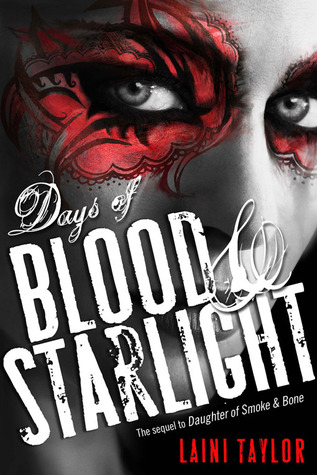
YA Book Pick: Days of Blood and Starlight

Once a month, we choose an outstanding YA book to review. We want to spotlight books of interest to aspiring writers, as well as highlight some of our favorite books and authors! 

Days of Blood & Starlight (Daughter of Smoke and Bone, #2)This month's book is my newest obsession DAYS OF BLOOD AND STARLIGHT, the follow-up to DAUGHTER OF SMOKE AND BONE, by Laini Taylor.  

Obsessed does not even begin to explain how I feel about this series.

Synopsis (from Goodreads): Once upon a time, an angel and a devil fell in love and dared to imagine a world free of bloodshed and war.

This is not that world.


Art student and monster's apprentice Karou finally has the answers she has always sought. She knows who she is—and what she is. But with this knowledge comes another truth she would give anything to undo: She loved the enemy and he betrayed her, and a world suffered for it.

In this stunning sequel to the highly acclaimed Daughter of Smoke & Bone, Karou must decide how far she'll go to avenge her people. Filled with heartbreak and beauty, secrets and impossible choices, Days of Blood & Starlight finds Karou and Akiva on opposing sides as an age-old war stirs back to life.

While Karou and her allies build a monstrous army in a land of dust and starlight, Akiva wages a different sort of battle: a battle for redemption. For hope.

But can any hope be salvaged from the ashes of their broken dream?


FIRST TWO LINES:  "PRAGUE, EARLY MAY. THE SKY WEIGHTED GREY OVER FAIRY-TALE ROOFTOPS, AND ALL THE WORLD WAS WATCHING."


At first blush this didn't seem like an earth-shattering, rich opening line.  But it's brilliant, for several reasons.  First, it drops readers right back into the previous story, where Karou and Akiva were filmed flying/fighting over the streets of Prague - we remember immediately that the sight of the angel and the blue haired girl captivated people from around the world.  Second, in a short and simple sentence, Taylor manages to set a beautiful scene and drop us right back into the Prague setting.


HIGHLIGHTS:


Daughter of Smoke and Bone (Daughter of Smoke and Bone, #1)2012 was the year of series for me.  I read many second, third and final series installments, and 95% of the time I was disappointed because the follow-up books didn't live up to the standards set by the first book(s) in the series.  This was not the case with Days of Blood and Starlight.  Not only did this story live up to the exceptionally high standards set by Daughter of Smoke and Bone, but in many ways it exceeded them. 

This was easily one of my favorite book in 2012. 

Fans of Taylor's will find the same rich character development and beautiful prose found in Daughter. The story is layered and complex, but Taylor still finds a way to craft the complexities without overt explanations. She is a master at developing vivid character voices that jump off the page - Zuzana, Karou's best friend, is perhaps one of my favorite characters of all time.

NOTES FOR WRITERS:


Taylor is a master at world building, character development and the ever-elusive voice.  Days (and Daughter) are must-reads for any writer looking for world building or character development inspiration.

For writers contemplating a series, consider Days an exemplary example of a sequel. Taylor shows us that sequels can be just as rich in magic and intrigue as the first book in a series.

A GOOD READ FOR:


Any fan of fantasy, or anyone looking for a truly unique story with beautiful writing.  But make sure to start with Daughter of Smoke and Bone before jumping into Days of Blood and Starlight.

Really, the only bad thing about this book is that we have to wait another year for the next one to come out.  Faster, Laini, faster!

Happy reading!  

Wednesday, January 16, 2013

Marketing Lesson: Your Brand vs. Your Product

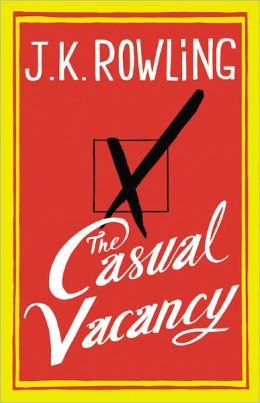
The Casual Vacancy
While I was home for the holidays, my mom and I were chatting about the latest J.K. Rowling novel, The Casual Vacancy.  Overall she was disappointed in the book.  Not because it was poorly written or because it was a bad story- quite the contrary. The main  reason she didn't like the book was because it wasn't what she expected from a J.K. Rowling story.

Said another way, there was a breakdown between brand and product. 

What is a brand exactly?


In it's most basic form, a brand is a promise.  It's a signal telling consumers what they should expect from any products that fall under a given brand name. 

As an example, let's use Tide. What are the things you expect from Tide as a brand?  You probably think of stain free, clean clothes. Perhaps you think of the scent of clean laundry when it's coming out of the dryer. 

No matter what products Tide launches - stain sticks, new fragrances, pods - you expect them to live up to the expectations you've developed based on your experience with other Tide products. If Tide products stop offering you that clean laundry experience that Tide represents to you, you might feel cheated.  And if it happens more than once, you may consider switching brands altogether.

When branded products stop living up to a brand's promise, the equity of that brand can erode. Consumers may be willing to forgive once, but overtime they will start to adjust their expectations for the brand, and  that adjustment will result in a loss of loyalty.

Your Name is Your Brand


In the writing world, your name is your brand.  Your products are the books you publish.  After you publish your first book, your name becomes a signal to readers about what to expect from future books written under your name.  If they liked what they read, they will want to see similar elements in future books written by you, and those expectations will drive future consumption of your books. 

In the case of Casual Vacancy, J.K. Rowling took a huge leap from the expectations  set by Harry Potter.  She went from a middle grade story filled with magic and whimsy, to an adult novel set squarely in the real world, dealing with real, and often heavy, issues. Any reader who purchased Casual Vacancy with Harry Potter expectations was bound to be let down because of the drastic differences between genre and target age group. 

Does this mean that Casual Vacancy shouldn't have been published?  Hell no.  She's J.K. F*cking Rowling.  She can write whatever the hell she wants.  But for the rest of us, our publisher, editor  and agent will want stories that leverage our existing fan base, and readers will hold you to the expectations set by previous books you've written.

This doesn't mean you can't write a middle grade story and later write an adult story.  But there will need to be shared traits between your MG and adult stories, such as genre, that links to your overall brand promise.  Otherwise you might get push back from your publisher and agent, or they may request that you publish the story under a pseudonym. 

No matter what, you should always write what you love. But be mindful of the expectations you will set from those early works - if you are lucky enough to have a fan base, your fans will want to see future products from you that mimic what they loved so much about your earlier works.

Sunday, January 13, 2013

Villain of the Month: Past Tense, "Um," "Because," and a Sandwich? (The Speech Patterns of Villains)


A man's seated with his arms on a table

After reading an admissions essay by James Holmes onScribd.com, I was frustrated that I couldn’t see any real foreshadowing markers to the horrible real-life villain he would become, and began to wonder if there were any markers of villainy in speech. Then I pulled up journal entries and the like from the Columbine murderers compiled by acclaimed journalist Dave Cullen (author of Columbine). The intimate writings are great resources, and well worth a read to pick up on nuance and cadence.

In furthering my research, I hit specificity jackpot.  I found some researchers (Jeffrey T. Hancock, Michael T. Woodworth and Stephen Porter) asking and answering the same linguistic question. What a great tool for making seating charts, navigating blind dates, and –most importantly – crafting the dialogue of a villain! Their analysis was focused on psychopaths and non-psychopaths talking about homicide, but I think that there are trends that may work really well for writing psychopathic characters even when not talking about homicide. Their findings were as follows:

1.      “Psychopaths (relative to their counterparts) included more rational cause and-effect descriptors (e.g., ‘because’, ‘since’).” Such an easy add to writing, and psychologically fascinating because it shifts the blame to the universe or the victim, and away from the villain. In writing a psychopath villain, keeping the mindset of universe-blame might be as valuable as the use of peppering the aftermath of one of his crimes with “because” and since.”


2.      “[Psychopaths] focused on material needs (food, drink, money), and contained fewer references to social needs (family, religion/spirituality).” Ooooh…how many chilly scenes can we reference of villains eating a victim’s sandwich or complaining about the sound of the air conditioning in the height of a killing? Tarrantino, the Cohen brothers, and the like know the balance of the horrific and mundane trick all too well. Who knew they were mirroring the linguistic patterns of psychopaths so perfectly?


3.      “Psychopaths’ speech contained a higher frequency of disfluencies (‘uh’, ‘um’) indicating that describing such a powerful, ‘emotional’ event to another person was relatively difficult for them.” Yikes! If saying “um” is a sign of psychopathy, I’m in trouble, but it seems that these disfluencies are at a time when others are talking about emotions. Not only can the “uh’s” help you craft a psychopath’s language, but may also help you linguistically show the difficulty one of your characters may have with a topic other than emotions or murder.


4.      “Psychopaths used more past tense and less present tense verbs in their narrative, indicating a greater psychological detachment from the incident, and their language was less emotionally intense and pleasant.” Interesting! Linguistically pushing events away from them/their crime by using time. Very sneaky. And an easy tool for mimicking a psychopath’s dialogue/line of thinking.


And for a final link on how to craft the psychopath’s language, the FBI used the findings listed above as part of a training on “The Language of Psychopaths” – an excellent article by the researchers listed above as well as a slew of other big-name experts in the field.