Wednesday, October 31, 2012

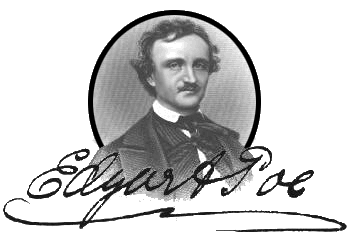
Edgar Allan Poe's Tips for Writing


It's Halloween, and Halloween means many things: candy, trashy costumes, a new The Simpsons Treehouse of Horror episode, and Poe readings throughout high school English classes everywhere. Since only one of those is a writer, I will delve into the last for today's post. More specifically, we'll look at what Poe had to say about writing.


A while ago Gotham Writer’s Workshop featured Poe and mockingly claimed that “in a recently-found treatise, he set down the following advice for bettering a story: *
1.     Employ an unreliable narrator, preferably one who doesn’t know he is insane and has no recollection of such events as digging into a grave to rip out the teeth of his recently departed lover.
2.     Include a beautiful woman with raven locks and porcelain skin, preferably quite young, and let her die tragically of some unknown ailment.
3.     Use grandiloquent words, such as heretofore, forthwith, and nevermore. A little Latin will also enhance the text.
4.     Do not shy away from such grotesqueries as inebriation, imprisonment, insanity, and men costumed as orangutans being burned to death.
5.     When in doubt, bury someone alive.
* Poe didn’t really compose this advice, but, as he was fond of a good hoax, we hope he would be pleased by this affectionate charade. “

Funny. But Edgar Allan Poe is so much more than that, and writers who want to build tension or get a little dark should be posing the question…what can budding writers learn from Poe about the creepy?  Here are some of my favorite takeaways from my Googling research:

1.       Poe on punctuation: “It does not seem to be known that, even where the sense is perfectly clear, a sentence may be deprived of half its force--its spirit--its point--by improper punctuation.” He then goes on to defend  the use of the dash by saying “The dash gives the reader a choice between two, or among three or more expressions, one of which may be more forcible than another, but all of which help out the idea. It stands, in general, for these words—‘or, to make my meaning more distinct.’ This force it has--and this force no other point can have; since all other points have well-understood uses quite different from this. Therefore, the dash cannot be dispensed with.”

2.       Poe believed that man should write backwards. “Godwin wrote his Caleb Williams backwards? He first involved his hero in a web of difficulties, forming the second volume, and then, for the first, cast about him for some mode of accounting for what had been done.”
 
3.       I’m not the only one with this idea. Last year one writer prepared for NaNoWriMo by reading Poe’s Philosophy on Composition and condensed it for the rest of us.
What do you think is Poe's genius? Has he inspired your writing in any way?

Monday, October 29, 2012

From Book to Screen (and back again): An Interview with New York Times No. 1 Bestselling Author Jay Asher


Thirteen Reasons Why
I first met best selling author Jay Asher at the SCBWI LA Conference in August.  He was a guest speaker and his presentation No Bookmarks Allowed! was both insightful and humorous.  I remember lining up with all the other inspired writers at the end of Jay's presentation, waiting for the chance to speak to him.  I hoped perhaps he would be up for a "From Book to Screen (and back again)" interview since Universal Studios optioned the film rights to his hit debut novel Thirteen Reasons Why.  You can imagine how nervous I was, after all, Thirteen Reasons Why was a New York Times Best Seller ...for over two years...and counting!  

Next in line, I readied my pitch, then sheepishly approached and blurted it all out in one fell swoop.  

His response: 

"Cool!".  

And that's pretty much the best way to describe Jay.  He's just a cool, fun guy with a "can do" attitude.

If you haven't read Thirteen Reasons Why, do because it's not only a beautifully written story that addresses hot button issues but it's also a great example of the writing process. What do I mean by that? Finish reading the novel, then read Thirteen Reasons Why (between the lines) at the end of the book.  Jay provides his answers to thirteen questions including "where did the overall idea for this book come from?" and "how did you decide on Hannah's thirteen reasons?".  What I love about this section is that Jay gives honest answers about his process and you soon realize it takes a lot to make something look so easy - a very inspiring tale for aspiring writers!

But enough about the process.  Now onto the interview!

JP: Did you ever dream that one day the film rights to Thirteen Reasons Why would be optioned?  We all know that the likelihood of having certain stars portray your characters on screen is slim to none but did you ever think "x or y would make a great Hannah or Clay?"

Jay Asher at SCBWI LA
JA: My favorite how-to-write books have always been screenwriting books. When I write, I probably think in more cinematic than literary terms. I visualize how each scene would look up on the screen, and that affects how I structure the scenes and which visual details I focus on. Since I've already imagined what the scenes would look like in a movie, I definitely let myself dream about one day seeing them in an actual theater. And sometimes, while writing, I'll watch a movie and think a certain actor would be interesting in one of the roles. But I started writing that book ten years ago, so those actors are too old for the parts now.
 
JP:  When you first found out that Thirteen Reasons Why was to be optioned, what went through your mind?

JA: When the offer came in from Universal, I was sitting in the back of an airport shuttle on my way to a speaking gig in Georgia. I was only allowed to tell certain people about the offer, and there was no way I could wait to reach my destination before telling them. The shuttle driver and the other passengers were annoyed by my constant texting and whispering into my phone. When they dropped me off, the driver even said, "I hope you didn't forget your phone."
 
JP: What surprised you most about the "option" process? 

JA: Not too much surprised me, mostly because I'd watched friends navigate the book-to-movie process and seen how every journey is different. I'd already let several offers pass as I waited for the right people to come along. When they did come along, I suppose I was a bit surprised by their personalities. We've all seen TV shows and movies where producers, actors, and all those Hollywood people act very...you know ...Hollywood! And maybe I'm just lucky, or maybe a project like Thirteen Reasons Why only attracts certain types of people, but everyone has been so down-to-earth and wonderful to work with. They're great at what they do, but they're also great people.
 
JP: What has been the funnest thing about the process so far?

Selena Gomez as Hannah
JA: Two moments stick out. The first happened when I went out to lunch with the producers and the screenwriter before the "official" business meeting was to begin. They began discussing the characters in Thirteen Reasons Why, and talking about them as if they were real people. In that moment, I thought back several years to when I began writing the opening pages to that book on my kitchen table. If that struggling writer could've eavesdropped into that conversation, he would've freaked! The other fun moment came when I attended a Selena Gomez concert with my wife, son, niece and nephew. (Selena is set to play the character of Hannah Baker.) We were in the middle of a mob of people from her fanclub, all waiting to go backstage. I noticed that a few of her fans had brought copies of my book for her to sign. When my wife told them who I was, they kind of freaked out.
 
JP: At what stage is the novel currently in the development cycle?

JA: I'm not supposed to get specific about what stage we're in, but things are moving in a positive direction. I had lunch with the producers two months ago, and it was exciting to hear some of the names being discussed. We all share a very similar vision for how we want this to look.
 
JP.  
If there’s one thing you would advise aspiring YA writers on the process of writing their first novel, what would that be?  And if there’s one thing you would advise a writer - with dreams of someday having their book optioned for a feature or TV production, what would that be?

The Future of Us
JA: When I write, I'm always thinking about what would make the book a page turner. Whether it's a novel dealing with serious issues or a comedy, if you can make it difficult for people to put your book down, you'll end up giving them a better reading experience. The same thing applies for books being turned into movies. If a producer reads a books, is fascinated by the story and can't put it down, it makes it so much easier to picture audiences not being able to get up to take a restroom break. 

 
JP: What are you currently working on and what can we expect next from Jay Asher?

JA: Something and someday. :-) 

 
JP: What are you currently reading?  And is there a book you would recommend others to read?

JA: I always have so many books going at once, and they're mostly non-fiction. When I'm writing, I can't enjoy much fiction because I overanalyze it. And I like to read several things at once so that, no matter what mood I'm in, there's always something to read. I did just finish Drama by Raina Telgemeier. I think it was only the third graphic novel I've read, and I completely enjoyed it.

You can find out more about Jay and his novels Thirteen Reasons Why and The Future of Us here.

Wednesday, October 24, 2012

My mini NaNoWriMo challenge (aka the kick in the pants I need)

A story has been circling around my brain for the last few months. My future MC's voice keeps elbowing me in my side, begging me to bring her to life. I have a mental outline. I have love interests, a villain, two red herrings and an opening chapter, but all of it is living inside of my head. Because for some reason I can't find the motivation to get off my @$$ and write.

Has this ever happened to you?

It wasn't that long ago that I started writing my current MS. I sat down. I started writing. I revised. Wrote some more. My memory makes me think it was an easy, natural process. So why is it that I can't find the motivation to start this new story that so clearly wants me to write it?

I think what I need is a good sharp kick in the pants. Which is why I am making my own NaNoWriMo pledge, right here, right now.

I hereby declare that by November 30, 2012, I, Stacy Stokes, will write 25,000 words or more of my as yet untitled story. No take backs. No excuses. You are my witness!

Participant 180x180 (2)For those of you who are not familiar, November is National Novel Writing Month (NaNoWriMo). Thousands of writers will challenge themselves with writing 50,000 words in a single month, and many of those 50,000 word first drafts will go on to become full fledged novels.  It's a lofty goal, and I applaud every single person who has taken the challenge or plans to take the challenge this November. Unfortunately my day job coupled with Thanksgiving travels makes 50,000 words a bit too lofty of a goal for me, which is why I'm setting my sights on 25,000. It's enough to get me started, and who knows? Maybe I'll come closer to 50,000 words than I thought. The goal is for me to get off my pajamaed @$$ and write!

For those of you interested in going for the gold, check out nanowrimo.org. There you can connect with other writers who have pledged to take the challenge, find the support and encouragement you need, along with other helpful writing support tools.

For those of you who aren't quite ready for the 50,000 word goal but are in desperate need for a kick in the @$$, post a comment here. I'm happy to be a writing buddy/cheerleader for anyone looking for a little extra support. And once you say it out loud it will be official - maybe that's all the motivation you need?

Hopefully you will all keep me honest.  25,000 words by November 30th. There's no taking it back now. Feel free to heckle me at will. (@stacyastokes)

Happy writing! 


Monday, October 22, 2012

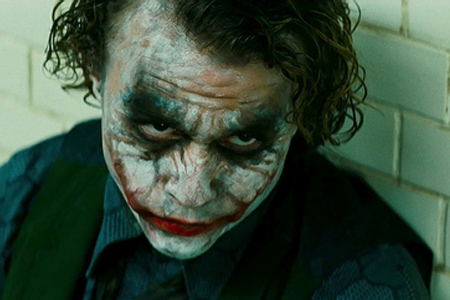
Villain of the Month: The Joker

I left you hanging last week. When a class of my high school students were posed the question: Who is the best villain of all-time, there were many nominated as you saw last month, but the hands-down winner was….THE JOKER!


Here is what they had to say about it:
·         Because he has no motive to being evil: he simply does bad things to cause destruction and problems.

·         He is the most likeable villain b/c he is so interesting in the crazy way he looks and his actions are crazy.

·         Because he is kreepy and is very crazy he has a personality that is really mean and just the way he looks is scary.

·         The Joker immediately comes to mind because the way he is played out is so differently evil. He acts evil in a way that you can also feel his emotions and his motives behind all the acts he does. –Jenny

·         Muahaha…he is very clever and quick and very spontaneous with his villainous crimes. Not to mention Batman actually has a struggle fighting him.

·         Because his name tells so much about him.

·         I don’t really know why he is the best villain but he is entertaining and interesting.

·         Because he is so interesting and creepy. His evil methods are so strange yet thrilling at the same time. –Kevin Lyle

·         Because he always knows people’s weaknesses and gets what he wants without any superpowers. He only takes advantage of people to get money or Batman. – Brandon Miller

·         Most likely because he intimidates me with his clown-like look and crazy thick red lips, and that haunting laugh.

·         The pure evil that pours from this character is un-paralleled. He has no motivation except to watch the world burn. Pure un-predictability. – Brendan Gallagher

·         Because he’s crazy and different from all of the other villains. He has his own style…

·         He is my favorite because Heath Ledger did such a good job playing and becoming the character. Also The Joker is such a unique character and he is unlike any other villain.

My students, when asked, were talking about Heath Ledger’s performance of The Joker in their responses.  I think that the reasoning behind WHY he is the best villain is helpful for tapping into the core of what is most terrifying to teenagers, and may help in the creation of villains written for that audience.
At the core of their fears seems to be the following key fears:

*No discernable motivation for his actions rendering him unpredictable. At a time in life when there are so many unknowns, this terror makes sense.
*Can read people’s weaknesses and exploit them. This seems to be a universal fear, but I often hear a sense of uncertainty in my students as to whether or not they can “pull” in regards to mischievous behavior; they are often testing the limits of what will be believed. And even at its more benign, teens aren’t quite sure yet how much others can see through them to their more vulnerable state.
*Unique/Different. Often “otherness” described in appearance. It’s Interesting this was mentioned so much when YA lit is often defined by a need to be different/finding your own uniqueness, and teenagers often claim to hate to be defined by appearance.

* He will do the villainous thing—the thing from which even Batman will struggle to protect us, thereby showing us that those who are to protect are imperfect and may fail.

Contrastingly, when I did a quick Google search to read about what journalists had to say about the Ledger Joker, most posts at the top of the search claimed he based his performance on Tom Waits, but there were many more nuanced readings to be found. They touched on many of the points the teens mentioned, but most, like this one, spoke of the terror one man might create on a macro-scale, something conspicuously absent in the teen responses. Interesting, especially when considering the dystopian trend sweeping YA Lit right now.

As for Ledger himself, he said: “ I just locked myself away and formed a little diary and experimented with voices... I ended up making him within the realm of a psychopath kind of like zero empathy or very little to no conscience towards his acts which is fun because there's no real limits on their boundaries to what he would say or how he would say something or what he would do...”

Wednesday, October 17, 2012

Workshops: Not Just For the Un-Published


I recently overheard a writer chatting to a friend about how one day when they get published, they won't have to attend all these conferences and workshops anymore.  To say that I didn't have this same thought when I first started writing would be lying.  I remember my first conference as a fantastic affair.  Still, you feel like a little fish in a very, very big pond especially when your value is rated by the word "published" in front of "writer".  I fathomed that once one reached the level of "published", it meant you should be the one lecturing at speaking engagements and not sitting in the audience engaging the speakers. 


But from these conferences and workshops, I grew to know many great writers, some published, some not who continue to attend these functions not just to meet publishers but to keep their skills fresh and to gleam ideas and perspectives they might otherwise miss holed up in their offices typing away. 

Duncan Conference Center
Novel Gurus Weekend Retreat
Duncan Conference Center
Workshops are especially helpful to published writers looking to write in a different age category or genre.  Where a writer's work may be stellar in middle grade, they may need new tricks of the trade and a fresh perspective to add spice to their foray into YA.


The last conference that I went to was SCBWI's LA conference which was a great event with round the clock speakers, activities and meet ups with old friends and new.  But the ones that really hit home for me, that I learned the most from as a writer were the more intimate workshops and smaller affairs.  The ones that offered opportunities for on the spot critique groups and small group presentations and work sessions. 

Which is why I'm very excited about two upcoming events. The first is Free Expressions Your Best Book workshop which is taking place in Charlotte, North Carolina starting this Friday.  This workshop offers an intimate setting for a small group of writers to learn from each other, to focus on their craft and projects and to meet with and listen to top agents, publishers and writers....for a week!  

The second is the Novel Gurus Weekend Retreat to be held in Delray Beach, Florida, March 1-3, 2013 where you get the opportunity to spend the weekend with two top publishers and freelance editor extraordinaire Lorin Oberweger.  The best part about this?  There's only room for 20 attendees!

Not everyone can afford to or have the luxury of attending all these workshop opportunities but for those who are published and think these aren't for them, I would say, think again, you just might find that it's more beneficial than you think.