I'm going on a cross-country trip next week and will be gone for more than two weeks, which means I'm thinking about the best ways to keep up the momentum on my current draft.
Here are some mobile apps that come highly recommended by other writers. I'm going to check out at least a few of these!
1. Scrivener for iOS
If you've been following this blog for a while, you've probably learned that I puffy-heart love the computer program Scrivener, the best drafting and organization tool around. They recently released a much-anticipated mobile version that syncs seamlessly with the desktop program. It looks like a great way to get a few hundred words in here and there in airports or before bed.
2. Evernote
Because I'm still in the ideas phase of my draft, you can bet I'm going to be using this mobile note-taking application frequently. Evernote saves notes, pictures, sketches, lists, and other items all in one place. It's then easy to access them on your main computer later.
3. Freemind
I haven't tried mind mapping as a way to organize a story, but it sounds really interesting. This app lets you easily create a mind map, or system of points branching out from a central topic. I used to like this method when it was mandatory in my English classes, so I might give it another try!
4. Pomodoro Timer
What writer doesn't have trouble with time management? This app follows a traditional pomodoro method time schedule (25 minutes working with a 3-5 minute break), which seems like an ideal short stretch for writing on the go.
What are your favorite mobile writing apps?
Showing posts with label writing. Show all posts
Monday, February 20, 2017
Friday, August 19, 2016
Interview with Author Rita Branches + a Chance to Win a $25 Amazon Gift Card!
I'm super excited to have author Rita Branches join us today. Rita is here to chat writing, publishing and her latest release, UNDER A MILLION STARS. Don't forget to scroll to the bottom of the post for a chance to win a $25 Amazon gift card!
Also, quick PSA: Make sure to swing by on Monday when we will be hosting New York Times Bestselling author Jay Asher as he talks about his hit novel 13 Reasons Why and its road to Netflix series. (Yes, THE Jay Asher. You don't wanna miss it!)
GIVEAWAY:
a Rafflecopter giveaway
Without further ado, please join me in giving Rita a huge Thinking to Inking welcome!
Hi Rita! Thanks so much for joining us to chat your latest release, Under a Million Stars. The cover is beautiful! Can you tell us a little but about your writing process for Under a Million Stars and how it differed from your debut, Painting Sky?
I actually wrote most of Under a Million Stars before Painting Sky, then I took a break because it’s a heavy book and it was difficult to write, even if I never went through anything like Charlie’s going through, it’s easy to enter the character’s head and feel like her. After finishing Painting Sky - which is much more easy going - I picked up Charlie’s and Jacob’s story and was able to give them a proper ending.
How do the ideas for your stories come to you? How did you come up with the idea for Under a Million Stars?
Honestly? I have no idea! They just come to me. It starts with just a tiny idea and then the characters come to life in my head, way before I put them on paper (or screen). The rest of their stories grow while I’m writing them.
What surprised you most about writing and publishing the second book vs. the first?
Like I said, I wrote most of Under a Million Stars before Painting Sky, but I must say that the ending came much more quickly than Painting Sky, the story unfolded in front of my eyes and I think I managed the perfect ending for their story, I also had Painting Sky’s reviews in mind while finishing this book. Readers’ opinions are very important - good, or not so good - to improve a writer’s way of working.
What advice would you give writers still working to make their publishing dreams a reality?
Do it! Yes, that’s my advice. Take a chance. I spent years writing and thinking about publishing and, even though I think I’m much more mature in my writing now, I wish I had taken a chance long ago.
What are you reading now?
I try to read so many books at the same time, it’s difficult to say, now I don’t have that much time to do it, but the paperback that I’m reading (and enjoying!) is ‘The Problem with Forever’ by Jennifer L. Armentrout
Who's your favorite character from Under a Million Stars?
Oh, that’s difficult! I loved almost all of them. Charlie and Jacob hold a sweet place in my heart, for obvious reasons. But I enjoyed Jacob’s parents and Kylie - their friend.
And, even though we don’t actually meet Jamie, I feel like I lost him too. Writing one chapter about him (you’ll have to read to know which) was the only time I ever cried while writing and editing that chapter broke my heart every time.
If you could be one character from any book or movie, who would it be?
We like to read about exciting stories and exciting characters with amazing lives but, in most books, there are problems that I wouldn’t want to face, so it’s difficult to say. In my favorite books the characters go through horrible obstacles, so, I choose to be just me ;)
I actually wrote most of Under a Million Stars before Painting Sky, then I took a break because it’s a heavy book and it was difficult to write, even if I never went through anything like Charlie’s going through, it’s easy to enter the character’s head and feel like her. After finishing Painting Sky - which is much more easy going - I picked up Charlie’s and Jacob’s story and was able to give them a proper ending.
How do the ideas for your stories come to you? How did you come up with the idea for Under a Million Stars?
Honestly? I have no idea! They just come to me. It starts with just a tiny idea and then the characters come to life in my head, way before I put them on paper (or screen). The rest of their stories grow while I’m writing them.
What surprised you most about writing and publishing the second book vs. the first?
Like I said, I wrote most of Under a Million Stars before Painting Sky, but I must say that the ending came much more quickly than Painting Sky, the story unfolded in front of my eyes and I think I managed the perfect ending for their story, I also had Painting Sky’s reviews in mind while finishing this book. Readers’ opinions are very important - good, or not so good - to improve a writer’s way of working.
What advice would you give writers still working to make their publishing dreams a reality?
Do it! Yes, that’s my advice. Take a chance. I spent years writing and thinking about publishing and, even though I think I’m much more mature in my writing now, I wish I had taken a chance long ago.
What are you reading now?
I try to read so many books at the same time, it’s difficult to say, now I don’t have that much time to do it, but the paperback that I’m reading (and enjoying!) is ‘The Problem with Forever’ by Jennifer L. Armentrout
Who's your favorite character from Under a Million Stars?
Oh, that’s difficult! I loved almost all of them. Charlie and Jacob hold a sweet place in my heart, for obvious reasons. But I enjoyed Jacob’s parents and Kylie - their friend.
And, even though we don’t actually meet Jamie, I feel like I lost him too. Writing one chapter about him (you’ll have to read to know which) was the only time I ever cried while writing and editing that chapter broke my heart every time.
If you could be one character from any book or movie, who would it be?
We like to read about exciting stories and exciting characters with amazing lives but, in most books, there are problems that I wouldn’t want to face, so it’s difficult to say. In my favorite books the characters go through horrible obstacles, so, I choose to be just me ;)
Thanks so much for stopping by, and congrats on the release of Under a Million Stars!
More about Under a Million Stars:
Hi! I'm Rita Branches. I was born and raised in in Portugal and I'm going to independently publish my debut novel in the Spring of 2016, Painting Sky. I am so happy that you decided to take a look at my work. Little bit about myself: along with being a writer, I am also a landscape architect. I started writing to bring 'to life' the stories that my mind created.
I LOVE to read. It was and always will be my passion.
Under a Million Stars
by Rita Branches
Genre: YA Contemporary Romance
Release Date: August 8th 2016
Can a beating heart bleed from the shattered pieces?
Her heart cracked when her best friend walked away; it completely shattered when she lost her family in a tragic accident.
Now orphaned at seventeen, Charlotte Peterson is forced to live with her former best friend, Jacob Parker. Charlie, a talented pianist, desperately wants their loving friendship back, but something is holding Jake back. The more she spirals into the darkness of depression, the more she needs him.
Jacob vowed to stay away from her—no matter how much he still loved her. Armed with secrets that would have destroyed both of their families, he chose to end their friendship and walk away, which nearly killed him. As he watches the girl he once knew begin to fade away, however, he realizes that their relationship is more important than the truth he's hiding.
Now it's up to Jacob to put the pieces of Charlie's broken heart back together—even if it means revealing the secrets he so desperately wants to protect her from.
Will Jacob find a way to bring back the carefree, talented girl he once knew, or is it too late for both of them?
by Rita Branches
Genre: YA Contemporary Romance
Release Date: August 8th 2016
Can a beating heart bleed from the shattered pieces?
Her heart cracked when her best friend walked away; it completely shattered when she lost her family in a tragic accident.
Now orphaned at seventeen, Charlotte Peterson is forced to live with her former best friend, Jacob Parker. Charlie, a talented pianist, desperately wants their loving friendship back, but something is holding Jake back. The more she spirals into the darkness of depression, the more she needs him.
Jacob vowed to stay away from her—no matter how much he still loved her. Armed with secrets that would have destroyed both of their families, he chose to end their friendship and walk away, which nearly killed him. As he watches the girl he once knew begin to fade away, however, he realizes that their relationship is more important than the truth he's hiding.
Now it's up to Jacob to put the pieces of Charlie's broken heart back together—even if it means revealing the secrets he so desperately wants to protect her from.
Will Jacob find a way to bring back the carefree, talented girl he once knew, or is it too late for both of them?
About the Author
Hi! I'm Rita Branches. I was born and raised in in Portugal and I'm going to independently publish my debut novel in the Spring of 2016, Painting Sky. I am so happy that you decided to take a look at my work. Little bit about myself: along with being a writer, I am also a landscape architect. I started writing to bring 'to life' the stories that my mind created.
I LOVE to read. It was and always will be my passion.
Author Links:
Wednesday, July 9, 2014
Take the Pressure Off...
While many of us who are unpublished worry about the stresses associated with writing, we're not the only writers who feel the pain. After chatting with several published friends, I've found that they tend to be more insecure about their writing than those who are pre-published. Fortunately, Elizabeth Gilbert has given a really insightful TED talk on how to alleviate some of the pressure of writing. If you haven't seen it yet, you should do yourself a favor and give it a listen.
http://www.ted.com/talks/elizabeth_gilbert_on_genius
Wednesday, October 31, 2012
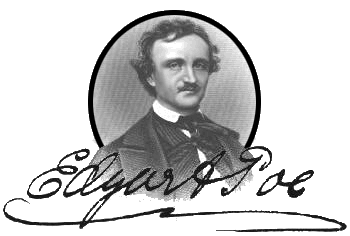
Edgar Allan Poe's Tips for Writing
It's Halloween, and Halloween means many things: candy, trashy costumes, a new The Simpsons Treehouse of Horror episode, and Poe readings throughout high school English classes everywhere. Since only one of those is a writer, I will delve into the last for today's post. More specifically, we'll look at what Poe had to say about writing.
A while ago Gotham Writer’s Workshop featured Poe and mockingly claimed that “in a
recently-found treatise, he set down the following advice for bettering a
story: *
1.
Employ an unreliable narrator, preferably one who doesn’t know he
is insane and has no recollection of such events as digging into a grave to rip
out the teeth of his recently departed lover.
2.
Include a beautiful woman with raven locks and porcelain skin,
preferably quite young, and let her die tragically of some unknown ailment.
3.
Use grandiloquent words, such as heretofore, forthwith, and
nevermore. A little Latin will also enhance the text.
4.
Do not shy away from such grotesqueries as inebriation,
imprisonment, insanity, and men costumed as orangutans being burned to death.
5.
When in doubt, bury someone alive.
* Poe didn’t really compose this advice, but, as he was fond of a
good hoax, we hope he would be pleased by this affectionate charade. “
Funny. But Edgar Allan Poe is so much more than that, and writers who want to build tension or get a little dark should be posing the question…what can budding writers learn
from Poe about the creepy? Here are some
of my favorite takeaways from my Googling research:
1.
Poe on punctuation: “It does not seem to be known that, even
where the sense is perfectly clear, a sentence may be deprived of half its
force--its spirit--its point--by improper punctuation.” He then goes on to defend the use of the
dash by saying “The dash
gives the reader a choice between two, or among three or more expressions, one
of which may be more forcible than another, but all of which help out the idea.
It stands, in general, for these words—‘or, to make my meaning more distinct.’
This force it has--and this force no other point can have; since all
other points have well-understood uses quite different from this. Therefore,
the dash cannot be dispensed with.”
2.
Poe believed that man should write backwards. “Godwin
wrote his Caleb Williams backwards? He first involved his hero in a web of
difficulties, forming the second volume, and then, for the first, cast about
him for some mode of accounting for what had been done.”
3.
I’m not the only one with this idea. Last year
one writer prepared for NaNoWriMo by reading Poe’s Philosophy on Composition
and condensed it for the rest of us.
What do you think is Poe's genius? Has he inspired your writing in any way?
Thursday, September 13, 2012
On Realizing I Might Fail
About a month ago I had a really bad day.
After months of polishing my query letter and putting the finishing touches on my manuscript, I was finally ready to put myself out there. I sent off my first batch of query letters and entered my first contest since wrapping revisions.
Then the day came for the contest participants to be announced. I opened blogger, heart pounding and hands sweating, sure that I would be among the chosen few selected to participate in the multi-agent event.
I wasn't. My entry didn't even get an honorable mention.
I opened my email in an attempt to distract myself. My first two form rejections were sitting in my inbox, smiling thier evil smiles.
I told myself that it was just a stupid contest and only a few measly rejections. There would be plenty of opportunities, the business is subjective, I was earning my stripes, it only takes one yes, etc. But something inside of me had shifted, because it was the first time I really considered the fact that I might fail.
Outside my window was a sea of grey - the fog had rolled in overnight, and San Francisco looked as bleak as I was starting to feel. It was July, but the temperature had dropped to the upper 50s. It was also Friday the 13th.
Several weeks later I went for a walk with a friend and lamented about my struggles. I looked her in the eye and said the words that had repeated in my head since that gloomy Friday afternoon: I might fail.
"Fail?" She said, eyebrows raising. "But you wrote a book. You. Wrote. A. Book. How is that failing?"
I'd never really thought about it that way.
I wrote a book. I actually finished an entire manuscript. In the process of doing that, I learned a ton about the publishing industry, met some new and wonderful people, improved my craft, started a blog, read and edited other writers' manuscripts, received positive reviews from beta readers (even had several stay up late reading because they couldn't put my story down). So why was I so obsessed with the idea of failure, when I had accomplished so much?
It's simple: I developed such a finite view of what success looked like that I lost sight of everything else. I couldn't see the trees for the forest, so to speak.
There are artists with paintings that will never make it past the refrigerator door, dancers who will never make it off the recital stage, and bands that will never make it out of their garage. But does that make them failures?
I would argue that the simple act of trying is a success in and of itself. How many people do you know that have actually attempted to make their dreams come true versus just talking and day dreaming about them? My guess is not many, because there is safety in not knowing.
For those of you who are on this crazy path to publication, don't forget to celebrate your small successes along the way. And don't lose sight of the biggest success of all - you wrote a book. You were brave enough to put yourself out there. You were brave enough to try. That alone deserves a little celebrating, no matter where your story ends up.
What have your recent successes been?
After months of polishing my query letter and putting the finishing touches on my manuscript, I was finally ready to put myself out there. I sent off my first batch of query letters and entered my first contest since wrapping revisions.
Then the day came for the contest participants to be announced. I opened blogger, heart pounding and hands sweating, sure that I would be among the chosen few selected to participate in the multi-agent event.
I wasn't. My entry didn't even get an honorable mention.
I opened my email in an attempt to distract myself. My first two form rejections were sitting in my inbox, smiling thier evil smiles.
I told myself that it was just a stupid contest and only a few measly rejections. There would be plenty of opportunities, the business is subjective, I was earning my stripes, it only takes one yes, etc. But something inside of me had shifted, because it was the first time I really considered the fact that I might fail.
Outside my window was a sea of grey - the fog had rolled in overnight, and San Francisco looked as bleak as I was starting to feel. It was July, but the temperature had dropped to the upper 50s. It was also Friday the 13th.
Pity Party, table for one.
"Fail?" She said, eyebrows raising. "But you wrote a book. You. Wrote. A. Book. How is that failing?"
I'd never really thought about it that way.
I wrote a book. I actually finished an entire manuscript. In the process of doing that, I learned a ton about the publishing industry, met some new and wonderful people, improved my craft, started a blog, read and edited other writers' manuscripts, received positive reviews from beta readers (even had several stay up late reading because they couldn't put my story down). So why was I so obsessed with the idea of failure, when I had accomplished so much?
It's simple: I developed such a finite view of what success looked like that I lost sight of everything else. I couldn't see the trees for the forest, so to speak.
There are artists with paintings that will never make it past the refrigerator door, dancers who will never make it off the recital stage, and bands that will never make it out of their garage. But does that make them failures?
I would argue that the simple act of trying is a success in and of itself. How many people do you know that have actually attempted to make their dreams come true versus just talking and day dreaming about them? My guess is not many, because there is safety in not knowing.
For those of you who are on this crazy path to publication, don't forget to celebrate your small successes along the way. And don't lose sight of the biggest success of all - you wrote a book. You were brave enough to put yourself out there. You were brave enough to try. That alone deserves a little celebrating, no matter where your story ends up.
What have your recent successes been?
Tuesday, July 31, 2012
Writer's Resource: LeechBlock, Freedom, Anti-social for Anti-procrastination
All those who spend a good portion of their time on the internet surfing random sites, checking comics, reading non-industry blogs, and otherwise messing around raise their hands. (Go ahead, I'll wait.)
One of the best things about the internet is the vast amount of interesting information available on virtually any topic. One of the worst things about the internet is--you guessed it--the vast amount of interesting information available on virtually any topic.
Writers have to balance their innate desire to LEARN ALL THE THINGS with the need to actually, yanno, write things every now and then.
Enter programs that forcibly remove you from the internet for a specified period of time. Dubbed "productivity tools" by their creators, they can be vastly helpful for writers. Here are three of the most popular ones:
LeechBlock: This Firefox add-on allows you to specify which sites you want to block and when you want to block them. If your writing time is from 7:30 a.m. to 9:00 a.m., you can tell LeechBlock that under no circumstances do you want to be able to check your Twitter feed during that time. From the website: "You can specify up to six sets of sites to block, with different times and days for each set."
One of the best things about the internet is the vast amount of interesting information available on virtually any topic. One of the worst things about the internet is--you guessed it--the vast amount of interesting information available on virtually any topic.
Writers have to balance their innate desire to LEARN ALL THE THINGS with the need to actually, yanno, write things every now and then.
Enter programs that forcibly remove you from the internet for a specified period of time. Dubbed "productivity tools" by their creators, they can be vastly helpful for writers. Here are three of the most popular ones:
LeechBlock: This Firefox add-on allows you to specify which sites you want to block and when you want to block them. If your writing time is from 7:30 a.m. to 9:00 a.m., you can tell LeechBlock that under no circumstances do you want to be able to check your Twitter feed during that time. From the website: "You can specify up to six sets of sites to block, with different times and days for each set."
Anti-Social (for Macs): This app specifically targets social media sites like Twitter and Facebook. You can also add custom sites to the list. You can get around this one by restarting your computer, but as the website says, "As you will feel a deep sense of shame for rebooting just to waste time on Twitter, you're unlikely to cheat.
Freedom: Available for both Macs and PCs for $10. This one takes it to the next level and just boots you off the internet entirely for a specified period of time.
If you're having trouble staying off of time-wasting sites, try out one of these productivity tools!
Thursday, July 5, 2012
Things I Learned In Improv Class, Volume 3: The Bell Game
What's improv comedy and why the heck am I writing about it? Check out the intro of Volume 1 and Volume 2 of this series for more info.
"I have to go home and walk my dog."
(ding)
"I have to go home and walk my cat."
(ding)
"I think I'll stay right here with you, forever and ever." *creepy stare*
Typically the first change of phrasing is closely linked to whatever was originally said. The next change is more drastic, or the complete opposite of what was originally said. It also usually gets the biggest laughs because of its juxtaposition to the original phrase.
Because the actors have no idea what phrase will illicit the bell ring, they can't plan ahead and are forced to think on the fly. Okay, that's kind of the whole point of improv in the first place, but the difference here is that the new phrase usually alters the direction of an existing scene. The case above is a perfect example - a scene where an actor goes home to walk their cat is much different from a scene with a stalker house guest that never leaves.
My current work in progress involves a seemingly infinite staircase to the afterlife. As you might imagine, the staircase is mentioned quite a bit.
If I shift + F7 the word 'staircase' I get the following results:
stairway
stairs
stair
flight of steps
set of steps
flight of stairs
Not very interesting. How else can I describe the staircase without actually using the above six phrases over and over again?
The staircase in my world is made of grey stone. A starting point for me is to think of other things that are made of stone, or are grey. It's also massive and seemingly endless, so I can leverage other things that fit this description.
To get myself into the "bell game" mindset, I set a timer for 60 seconds and start making a list of everything I can think of that is grey, stone, or some visual representation of a staircase. The idea is to take myself out of my head and into stream-of-consciousness mode, where I may uncover some new ways to describe a staircase beyond those provided by my good friend Shift F7.
Staircase
Stone staircase
Monolith
tombstone
ancient relic
pyramid
ruins
archaic
bleak
Stonehenge
zig-zagging stone
teeth
chomping teeth
teeth chomping at the sky
stack of squares
stack of right angles
stack of rocks
jagged rocks
jagged grey
mountain
hill
Sisyphus
And as you can see, my ideas deviated in several different directions, which is exactly what you want. I might not describe a staircase as Sisyphus, but the act of climbing a staircase might make someone feel like Sisyphus, so in that way the ideas are all connected, and potentially usable.
If I wanted to build the list further, I might pick one of the more random descriptions as my anchor point and go for another 60 seconds. What would come out of 60 seconds of stream-of-conscious writing about a tombstone or a stack of right angles?
The next time you're stumped, or if you need to describe something in multiple ways throughout your story, pull out the stopwatch and see what happens when you let your subconscious take over with a mini brainstorming session. It might be just the thing you need to kick start your creativity.
Happy writing!
Today's Lesson: The Bell Game
If you've ever watched Drew Carey's Whose Line is It Anyway, you may have seen a version of the bell game. It's a classic, and one of my favorites. In it, the actors on stage improvise a scene, while another member of the team (Drew Carey in the case of Who's Line) watches and rings a bell at random intervals during the scene. When the bell is rung, the improviser has to alter whatever noun or phrase they just said. Typically the bell ringer will have the actor change their words three times, or as many times as it take to get a big laugh from the audience. Here's an example:"I have to go home and walk my dog."
(ding)
"I have to go home and walk my cat."
(ding)
"I think I'll stay right here with you, forever and ever." *creepy stare*
Typically the first change of phrasing is closely linked to whatever was originally said. The next change is more drastic, or the complete opposite of what was originally said. It also usually gets the biggest laughs because of its juxtaposition to the original phrase.
Because the actors have no idea what phrase will illicit the bell ring, they can't plan ahead and are forced to think on the fly. Okay, that's kind of the whole point of improv in the first place, but the difference here is that the new phrase usually alters the direction of an existing scene. The case above is a perfect example - a scene where an actor goes home to walk their cat is much different from a scene with a stalker house guest that never leaves.
So what's this got to do with writing?
The bell forces quick, stream-of-conscious thinking. It takes the actor out of their head and forces them to come up with a new idea on the fly. As a writer, you can't exactly "bell" yourself, but you can use similar tactics to take yourself out of your head when you need to come up with a new idea or way to describe something.My current work in progress involves a seemingly infinite staircase to the afterlife. As you might imagine, the staircase is mentioned quite a bit.
If I shift + F7 the word 'staircase' I get the following results:
stairway
stairs
stair
flight of steps
set of steps
flight of stairs
Not very interesting. How else can I describe the staircase without actually using the above six phrases over and over again?
The staircase in my world is made of grey stone. A starting point for me is to think of other things that are made of stone, or are grey. It's also massive and seemingly endless, so I can leverage other things that fit this description.
To get myself into the "bell game" mindset, I set a timer for 60 seconds and start making a list of everything I can think of that is grey, stone, or some visual representation of a staircase. The idea is to take myself out of my head and into stream-of-consciousness mode, where I may uncover some new ways to describe a staircase beyond those provided by my good friend Shift F7.
Staircase
Stone staircase
Monolith
tombstone
ancient relic
pyramid
ruins
archaic
bleak
Stonehenge
zig-zagging stone
teeth
chomping teeth
teeth chomping at the sky
stack of squares
stack of right angles
stack of rocks
jagged rocks
jagged grey
mountain
hill
Sisyphus
And as you can see, my ideas deviated in several different directions, which is exactly what you want. I might not describe a staircase as Sisyphus, but the act of climbing a staircase might make someone feel like Sisyphus, so in that way the ideas are all connected, and potentially usable.
If I wanted to build the list further, I might pick one of the more random descriptions as my anchor point and go for another 60 seconds. What would come out of 60 seconds of stream-of-conscious writing about a tombstone or a stack of right angles?
The next time you're stumped, or if you need to describe something in multiple ways throughout your story, pull out the stopwatch and see what happens when you let your subconscious take over with a mini brainstorming session. It might be just the thing you need to kick start your creativity.
Happy writing!
Thursday, June 7, 2012
Things I Learned In Improv Class, Volume 2: You Are Not The Star
Improv comedy is a form of live theatre in which the plot, characters and dialogue of a scene are made up in the moment, without a script.
In this series of posts I'd like to share some of the tools I learned during the three years I studied improv comedy in Chicago, and show you how I apply them to my writing.
Today's lesson: you are not the star
One of the hardest pills any aspiring improv actor must swallow is the idea that they are not the star of their scenes. Improv is a team sport, so spotlight stealers beware - nobody wants to work with someone who's only in it for themselves.
A scene ends after a big laugh. Why? Because there's usually nowhere else to take it once you hit the punchline, and you always want to end on a high note.
People who come out of the gate swinging with funny one-liners and punchy jokes kill the scene before it's started. The truly great improvisers are able to take time and build scenes out so that they not only get a chuckle, but they get side-splitting laughs and thundering applause.
Even better than that, the truly great improvisers are experts at setting their scene partners up for success. They don't focus on themselves and making everyone think they're funny - they focus on making the scene funny. Even if that means giving the big laughs to someone else.
A scene ends after a big laugh. Why? Because there's usually nowhere else to take it once you hit the punchline, and you always want to end on a high note.
People who come out of the gate swinging with funny one-liners and punchy jokes kill the scene before it's started. The truly great improvisers are able to take time and build scenes out so that they not only get a chuckle, but they get side-splitting laughs and thundering applause.
Even better than that, the truly great improvisers are experts at setting their scene partners up for success. They don't focus on themselves and making everyone think they're funny - they focus on making the scene funny. Even if that means giving the big laughs to someone else.
So what's this got to do with writing?
I love me some metaphors. Similes? Check. Analogies? You betcha. I love nothing more than crafting a beautiful sentence that will make readers sit back and say, damn, that girl can write!
The problem is that beautifully constructed sentences and flowery comparisons may not be the right thing for my story or the voice of my character. And really, it shouldn't be about making a reader sit back and marvel at a single sentence - it should be about making them sit back and marvel at the story.
Essentially, I am not the star of the stories I write - my characters are. By focusing on myself I am doing my story a massive disservice, because I'm taking the voice away from my character and giving it to me. Me, me, me.
Learning to let go during revisions
At first, revisions were extremely hard for me. I had trouble cutting sentences or sections of the story that weren't really working, so instead I would try to write around them and force them to fit.
Then one day I started letting go (see my first post about saying 'yes, and' to critiques) and the most amazing thing happened - I was free! The scenes read smoother, my characters were more consistent and my story was much, much stronger. All I had to do was learn to let go of the scene or sentence that I was, for whatever reason, so enamored with, and focus instead on my characters.
No matter how much you love your writing, if it's not doing your story any good then it's time to say goodbye. Remember - you are not the star, your story is. Focus on what's best for your story and your characters, and you will never go wrong.
Happy writing!
Tuesday, May 8, 2012
On Writing First Chapters
Hey, look at me! I’m blogging. I’m a blogger!
Now that that’s out of the way, on to my inaugural blog post. And what better topic for a first blog post than a post about first chapters? I agree. It’s genius.
It’s also been the bane of my existence for the last six months.
I initially thought my current MS’s first chapter was a sparkling example of literary genius at its finest. It was full of witty insights into my character’s snarky persona. It dripped with back story. Similes and metaphors exploded off the page in Times New Roman wonder. It was funny. It was dark. It was clever.
It was all wrong.
Turns out I’d fallen victim to many of the faux pas writers succumb to when starting out their stories. It took me six rewrites, five beta readers, three fabulous critique/blog partners and one workshop to finally get it to the right place...I think. (Head, meet wall.)
The reality is, first chapters are hard. They’re also arguably the most important part of a story, because they need to entice readers (and for those of us aspiring writers, agents) to read more, while simultaneously setting a reader’s expectations for what’s to come.
It was somewhere around revision four that I stumbled upon this useful list of first chapter faux pas from Writers Digest: What Agents Hate.
Let’s just say I could relate to a few of the items on the list.
The article was a light bulb moment for me. Thankfully, I discovered I’m not alone in my struggle for the perfect opening and there are tons of resources out there that helped me wade through the chapter one muck. Below are a few of my favorites.
This post does a nice job of outlining how to approach first chapter revisions: The All Important First Chapter
This post has some handy tools to help you work through where to start your novel: Where To Start
In these posts, agent Kathleen Ortiz reviews the first 5 pages of several MS and outlines where (and why) she stopped reading: First 5 Pages Part One, First 5 Pages Part Two, First 5 Pages Part Three
More on what not to do: Don’t Do This, 13 Ways Not To Start A Novel
More on where to start: Opening Your Story
It was all wrong.
The reality is, first chapters are hard. They’re also arguably the most important part of a story, because they need to entice readers (and for those of us aspiring writers, agents) to read more, while simultaneously setting a reader’s expectations for what’s to come.
It was somewhere around revision four that I stumbled upon this useful list of first chapter faux pas from Writers Digest: What Agents Hate.
Let’s just say I could relate to a few of the items on the list.
The article was a light bulb moment for me. Thankfully, I discovered I’m not alone in my struggle for the perfect opening and there are tons of resources out there that helped me wade through the chapter one muck. Below are a few of my favorites.
This post does a nice job of outlining how to approach first chapter revisions: The All Important First Chapter
This post has some handy tools to help you work through where to start your novel: Where To Start
In these posts, agent Kathleen Ortiz reviews the first 5 pages of several MS and outlines where (and why) she stopped reading: First 5 Pages Part One, First 5 Pages Part Two, First 5 Pages Part Three
More on what not to do: Don’t Do This, 13 Ways Not To Start A Novel
More on where to start: Opening Your Story
Have other great first chapter resources? Post them here!
Happy writing!
Happy writing!
Subscribe to:
Posts (Atom)