Showing posts with label Self Publishing. Show all posts
Wednesday, September 27, 2017
Self-Publishing — Is It Right for You?
"Are you going to self-publish?" "Did you know you can put your book on Amazon and sell it?" "Why are you wasting time trying to get an agent if you can just do it yourself?"
If you're pursuing traditional publication and you aren't a runaway success story, you've probably had well-meaning friends and relatives ask you about self-publishing (I know I have!). It can sometimes be tough to explain your reasoning when it's taking years to make forward progress.
One very good reason? Self-publishing the right way, to give yourself the best chance of success, is expensive. Author Susanne Dunlap published a blog post this week that breaks down the costs, including cover design, editing, and social media marketing.
Distribution can be an issue, too. If you've always dreamed of seeing your work in the checkout line at Target or at the Scholastic Book Fair, you'll have a much better shot if you publish traditionally.
Of course, the decision between self and traditional publishing is largely dependent on your goals. Do you want to make a career out of writing, or are you happy if it's something you do on the side around your day job? Do you enjoy and/or are you good at marketing yourself? (It's important to note, though, that traditional publishers expect their authors to carry a good chunk of the marketing load themselves these days too.)
Here are some good resources for researching the pros and cons of self-publishing:
Writer's Digest — The Pros and Cons of Self Publishing (& Traditional Publishing)
NY Book Editors — TRADITIONAL OR SELF-PUBLISH: WHAT’S BEST FOR YOU?
Business Know-How — Advantages and Disadvantages of Self-Publishing
Wednesday, March 8, 2017
Should You Hire an Editor?
I generally spend just as long editing as I do drafting, so naturally I've wondered from time to time whether it would be worth it to hire a freelance editor. On my last manuscript, I splurged on a first-chapter edit from a talented editor friend of mine, and it was hugely helpful in identifying the weak points.
Here are some points to consider before you hire an editor for your manuscript.
1. Do your prep work before you take the plunge.
To get the most out of your editing experience, you need to make sure your manuscript is in the absolute best shape you can get it before you send a word of it out to an editor. This means resisting the temptation to send it when you're heartily sick of it and just want to write something else (trust me, we've all been there!).
Books & Such Literary Management has a great blog post that covers some other vital preliminary steps.
2. Check compatibility.
As you probably know if you've worked with critique partners in the past, it's important to make sure you mesh well with someone who's giving you notes on your work. Try to talk to past clients of the editor to make sure they were happy with their experience. In addition, most editors will give you a few pages of edits for free—that way you can make sure their edits will work for you before you commit to anything further.
3. Get the most bang for your buck.
Editors' rates vary, but in general you can expect to pay at least a few hundred dollars (and often a lot more than that) for a full, in-depth manuscript critique. If this is a little rich for your blood, you can choose to focus on key parts of your manuscript. For example, if you're not getting a good response from sending the first few chapters to agents, hire an editor to look at them. They'll be able to tell you any immediate turnoffs that might be causing the problem. Many editors will also work on query letters, synopses, and even contest pitches.
4. Going indie? Don't skimp on the editing.
There are many advantages to self-publishing, like complete creative control and the ability to put books out on whatever schedule works best for you. But it's important to remember that you won't have access to professional editors, copyeditors, and proofreaders like you would if you went the traditional publishing route. This makes hiring a top-notch freelance editor a really, really good idea. I have two friends who have built up a huge following by self-publishing books, and both of them consider extensive work with a freelance editor as an essential part of the process.
Have you worked with a freelance editor before? What was your experience?
Here are some points to consider before you hire an editor for your manuscript.
1. Do your prep work before you take the plunge.
To get the most out of your editing experience, you need to make sure your manuscript is in the absolute best shape you can get it before you send a word of it out to an editor. This means resisting the temptation to send it when you're heartily sick of it and just want to write something else (trust me, we've all been there!).
Books & Such Literary Management has a great blog post that covers some other vital preliminary steps.
2. Check compatibility.
As you probably know if you've worked with critique partners in the past, it's important to make sure you mesh well with someone who's giving you notes on your work. Try to talk to past clients of the editor to make sure they were happy with their experience. In addition, most editors will give you a few pages of edits for free—that way you can make sure their edits will work for you before you commit to anything further.
3. Get the most bang for your buck.
Editors' rates vary, but in general you can expect to pay at least a few hundred dollars (and often a lot more than that) for a full, in-depth manuscript critique. If this is a little rich for your blood, you can choose to focus on key parts of your manuscript. For example, if you're not getting a good response from sending the first few chapters to agents, hire an editor to look at them. They'll be able to tell you any immediate turnoffs that might be causing the problem. Many editors will also work on query letters, synopses, and even contest pitches.
4. Going indie? Don't skimp on the editing.
There are many advantages to self-publishing, like complete creative control and the ability to put books out on whatever schedule works best for you. But it's important to remember that you won't have access to professional editors, copyeditors, and proofreaders like you would if you went the traditional publishing route. This makes hiring a top-notch freelance editor a really, really good idea. I have two friends who have built up a huge following by self-publishing books, and both of them consider extensive work with a freelance editor as an essential part of the process.
Have you worked with a freelance editor before? What was your experience?
Wednesday, January 29, 2014
This Is How You Do It: Lumiere
Nick Morgan of Forbes noted last year that "there are somewhere between 600,000 and 1,000,000 books published every year in the US alone, depending on which stats you believe. Many of those - perhaps as many as half or even more - are self-published. On average, they sell less than 250 copies each. Your book won't stand out. Hilary Clinton's will. Yours won't."
Wow, that's a bit depressing isn't it? Well, for those of us that are okay with sending our novels out into the ether and waiting for things to "happen", it probably is. But for others like author Jacqueline Garlick, well, she's not going to sit there and twiddle her thumbs, she's going to make things move.
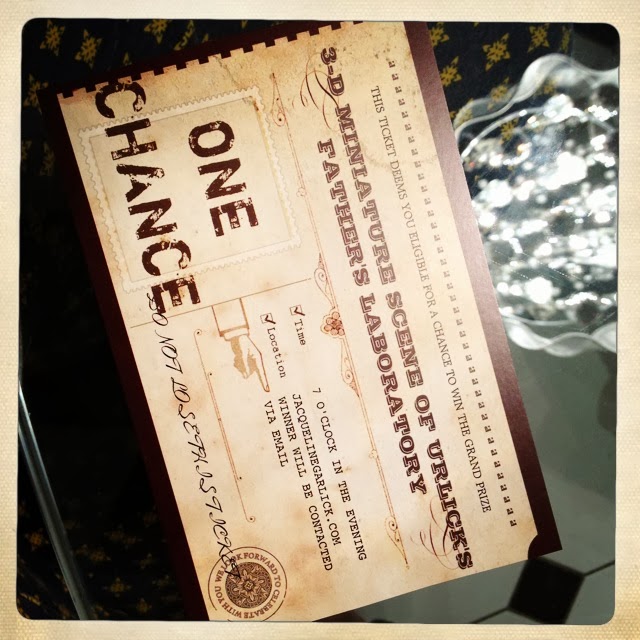
Which brings me to the amazingness of what this author/entrepreneur has created for her readers. To celebrate the launch of her steam punk novel Lumiere, Garlick offered special limited editions to her first one hundred fans. I just received mine today and well, I'll let the photos speak for themselves.
![]() |
| A package in the mail! |
![]() |
| Everything you need to start your steam punk adventure. Eyelet's favourite candy and tea! |
![]() |
| Special note from Lumiere's Urlick & Eyelet |
![]() |
| A clue to a secret letter. Check out jacquelinegarlick.com to find out the answer! |
![]() |
| A cool contest for the lucky 100 |
![]() |
| Original artwork by Jacqueline Garlick and conceptual art piece by Tanner Fife |
![]() |
| The coolest piece - a prototype of Urlick's latest invention - a pickle stabber! |
Labels:
Forbes,
Jackie Garlick,
Jenn,
Lumiere,
Self Publishing
Monday, November 18, 2013
Industry Month In Review: "I Think I Can!, I Think I Can!"
We're midway through nanowrimo and while I've decided not to participate this year (it's been quite an epic first half of the month personally for me so far!), I'm sitting on the sidelines with pom-poms in hand, cheering on my fellow writers brave enough to follow through with this tough assignment. Go team, go!
As we make our way to the end of the year, many things slow down. Cold weather, holidays and the abundance of turkey and gravy are just a few hurdles that stand in our way. It's easy to make excuses, to put gift shopping in front of writing (who wants to be that guy who brought the box of convenience store chocolates to Christmas) but for some, this is the time when things really pick up. It's the pre-holiday season and books need to be out there to be bought, gifted and read. Timing is everything.
Over the past few months, I've had the opportunity to witness first hand a few close friends and their foray into the indie scene. Self publishing is not just about uploading your manuscript online and praying for fame and fortune. It's about discipline, marketing and making sure you surround yourself with the right team. Author Allison Winn Scotch provides some fantastic insight into her journey into self pub and if you're thinking of moving in that direction, her article on Writer Unboxed is a must read.
But what if you're not at the stage where you have a final manuscript ready for the masses? What if you're only at the beginning of your story when the log line is still something that causes you great anxiety? Not to worry, take a deep breath. There's no rush to make the black Friday deadline. Heather Jackson of Write On Sisters just posted a great article on the importance of theme. Grab a coffee and have a read, then sit back and take some well deserved time to think of what the theme(s) of your manuscript are. It may feel like a lot of time just "sitting" but trust me, it'll save a lot of valuable time when it comes to "writing".Finally, what's the holiday season without holiday blockbusters and with the recently released Ender's Game and The Hunger Games: Catching Fire coming out this Friday, what better excuse is there to put down the pen (I promise, it won't hurt), relax the brain and enjoy some eye candy for a few hours? Still hungering for more YA blockbusters? Simon Reynolds of Digital Spy talks about how YA Lit is Reshaping the Hollywood Blockbuster and highlights four highly anticipated eagerly anticipated YA adaptations.
Happy Thanksgiving to my American compadres!
Friday, October 4, 2013
To Self Pub or Not To Self Pub...
Self pub seems to be the hot topic these days. Indeed we're seeing so many books on the scene, in Good Reads, fan fiction websites, Kobo, Amazon, you name it. It's everywhere, and for the average reader, this can be daunting. How do you weed the good from the bad? Where do you invest your time and energy? For writers, at first it may seem like a great idea, but most often, it's like running up a river with piranhas nipping at your toes.
So how do you do it right? It's hard to think of your labour of love objectively. I could probably go on and on about this topic but I'll highlight what I think are three key assets to break free of the self pub muck and have the potential to become a real indie breakout novel.
1. Independent Editors
You've invested months, maybe years of your time to create your piece de resistance. It sounds like music to your ears. You pat yourself on the back for those witty lines or gorgeous paragraphs that paint a landscape worthy of being called a Monet with words.
There lies the problem.
It may be a masterpiece to you, but is it a masterpiece for the market? Investing in an independent editor may seem like an unnecessary expense but you will soon find that the right one is invaluable. Why? Because they've done it a thousand times, they know your market and they know story. A great editor will also tell you the things you don't want to hear...that your story isn't perfect and they'll guide you to make changes to make it better. Readers read books and often times they have no idea why they don't like it. They feel unfulfilled, bored, or frustrated with the protagonist. An independent editor will help you to identify the issues in your manuscript that the readers can't communicate and fix them. She's a secret I'd love to keep because she's that good, but if you're thinking of hiring one, check out Lorin Oberweger - might as well start with the best!
2. Covers
Don't judge a book by its cover...unless what you're talking about is actually a book. What sets self pub apart from trad pub is that you have the ultimate control. You can decide what your cover will look like. Self pub author and workshop guru Jacqueline Garlick has one of the hottest anticipated releases this Fall with the first in her Illumination Paradox series LUMIERE. Check out her post here where she outlines in detail the intensive process she went through to make her cover the gorgeous artwork it is today. Many authors in this arena seem satisfied with using stock photos but Garlick took it one step further and created her own. I know what you're thinking - another cost? And yes, this can run upwards of several thousand dollars, but this is a product, it won't sell itself. Think of the cover as your calling card and a reader's first impression. If it looks like it was slapped together in two minutes, you can bet most people will assume what's inside was done the same way.
3. Marketing
We're writers, we don't promote. We huddle in our corners and play in the fictional worlds we've created. Unfortunately, if we continue to do so, the only ones who will come play with us are probably also in our heads. If you want your book to be a success, you need to be out there, making a mark on your readers. They need to feel connected with you and interested in what you say. Since you don't have that publishing machine behind you, that's all the more reason to get out there and make a statement. Otherwise, how is a reader going to decide between spending their time reading a NYT Bestselling YA Dystopian novel and your self pub book that's currently number 750 on the list (and that's actually good!).
So my thoughts on self pub - it's a great option...for the right book. Great cover, fantastic edits (combined with positive feedback from professionals) plus a solid dose of marketing hutzpah courtesy of the writer = a book that will rise above the rest and become the beautiful needle in a haystack (in a good way!).
So how do you do it right? It's hard to think of your labour of love objectively. I could probably go on and on about this topic but I'll highlight what I think are three key assets to break free of the self pub muck and have the potential to become a real indie breakout novel.
1. Independent Editors
You've invested months, maybe years of your time to create your piece de resistance. It sounds like music to your ears. You pat yourself on the back for those witty lines or gorgeous paragraphs that paint a landscape worthy of being called a Monet with words.
There lies the problem.
It may be a masterpiece to you, but is it a masterpiece for the market? Investing in an independent editor may seem like an unnecessary expense but you will soon find that the right one is invaluable. Why? Because they've done it a thousand times, they know your market and they know story. A great editor will also tell you the things you don't want to hear...that your story isn't perfect and they'll guide you to make changes to make it better. Readers read books and often times they have no idea why they don't like it. They feel unfulfilled, bored, or frustrated with the protagonist. An independent editor will help you to identify the issues in your manuscript that the readers can't communicate and fix them. She's a secret I'd love to keep because she's that good, but if you're thinking of hiring one, check out Lorin Oberweger - might as well start with the best!
2. Covers
Don't judge a book by its cover...unless what you're talking about is actually a book. What sets self pub apart from trad pub is that you have the ultimate control. You can decide what your cover will look like. Self pub author and workshop guru Jacqueline Garlick has one of the hottest anticipated releases this Fall with the first in her Illumination Paradox series LUMIERE. Check out her post here where she outlines in detail the intensive process she went through to make her cover the gorgeous artwork it is today. Many authors in this arena seem satisfied with using stock photos but Garlick took it one step further and created her own. I know what you're thinking - another cost? And yes, this can run upwards of several thousand dollars, but this is a product, it won't sell itself. Think of the cover as your calling card and a reader's first impression. If it looks like it was slapped together in two minutes, you can bet most people will assume what's inside was done the same way.
3. Marketing
We're writers, we don't promote. We huddle in our corners and play in the fictional worlds we've created. Unfortunately, if we continue to do so, the only ones who will come play with us are probably also in our heads. If you want your book to be a success, you need to be out there, making a mark on your readers. They need to feel connected with you and interested in what you say. Since you don't have that publishing machine behind you, that's all the more reason to get out there and make a statement. Otherwise, how is a reader going to decide between spending their time reading a NYT Bestselling YA Dystopian novel and your self pub book that's currently number 750 on the list (and that's actually good!).
So my thoughts on self pub - it's a great option...for the right book. Great cover, fantastic edits (combined with positive feedback from professionals) plus a solid dose of marketing hutzpah courtesy of the writer = a book that will rise above the rest and become the beautiful needle in a haystack (in a good way!).
Subscribe to:
Posts (Atom)